October 2012
| Items | |
|---|---|
|
Sunday, October 7 at MOCA Grand Avenue
MOCA Grand Avenue
Meet up with friends or bring your family to MOCA for a social, open studio workshop. Explore Destroy the Picture: Painting the Void 1949–1962 through conversation and careful looking, then experiment with the art of creative destruction. We've got art materials appropriate for a range of ages and ability levels, including adults. Snacks and beverages are available for purchase from Lemonade Café at MOCA, and are welcome in the artmaking area.
Meet up with friends or bring your family to MOCA for a social, open studio workshop. Explore Destroy the Picture: Painting the Void 1949–1962 through conversation and careful looking, then experiment with the art of creative destruction. We've got art materials appropriate for a range of ages and ability levels, including adults. Snacks and beverages are available for purchase from Lemonade Café at MOCA, and are welcome in the artmaking area.FREE; no reservations required
Sunday Studio
Sunday Studio
![]()
Meet up with friends or bring your family to MOCA for a social, open studio workshop. Explore Destroy the Picture: Painting the Void 1949–1962 through conversation and careful looking, then experiment with the art of creative destruction. We've got art materials appropriate for a range of ages and ability levels, including adults. Snacks and beverages are available for purchase from Lemonade Café at MOCA, and are welcome in the artmaking area. Add to my Calendar
Sunday, October 7 at MOCA Grand Avenue
MOCA Grand Avenue
Join Exhibition Curator Paul Schimmel for a dynamic walkthrough of Destroy the Picture: Painting the Void, 1949—1962. FREE with museum admission
Join Exhibition Curator Paul Schimmel for a dynamic walkthrough of Destroy the Picture: Painting the Void, 1949—1962.
FREE with museum admission
Art Talk: Paul Schimmel on Destroy the Picture
![]() 20121007T150000
20121007T150000
3pm
Join Exhibition Curator Paul Schimmel for a dynamic walkthrough of Destroy the Picture: Painting the Void, 1949—1962. FREE with museum admission Add to my Calendar
Sunday, October 7 at MOCA Grand Avenue
MOCA Grand Avenue
The Museum of Contemporary Art, Los Angeles, presents The Panza Collection and Selections from Major Gifts of Beatrice and Philip Gersh, Rita and Taft Schreiber, and Marcia Simon Weisman, now on view through January 14, 2013 at MOCA Grand Avenue. The exhibition celebrates the core of the museum's internationally renowned collection, which evolved as a result of the acquisition of The Panza Collection in 1984, considered at the time as one of the world's most important acquisitions of contemporary art and a turning point in the museum's early history. This exhibition also marks the first time since 2000 that almost the entire Panza Collection has been presented at MOCA. Installed by MOCA Senior Curator Alma Ruiz, The Panza Collection and Selections from Major Gifts of Beatrice and Philip Gersh, Rita and Taft Schreiber, and Marcia Simon Weisman features 92 works, comprising paintings, sculptures, and works on paper that serve both as evidence of the intellectual and emotional challenge that is involved in collecting and as a testament to exemplary civic patronage and its enduring legacy in the cultural growth of Los Angeles.
The Panza Collection and Selections from Major Gifts of Beatrice and Philip Gersh, Rita and Taft Schreiber, and Marcia Simon Weisman
20121007
20121007
Aug 20, 2012-Feb 10, 2013
The Museum of Contemporary Art, Los Angeles, presents The Panza Collection and Selections from Major Gifts of Beatrice and Philip Gersh, Rita and Taft Schreiber, and Marcia Simon Weisman, now on view through January 14, 2013 at MOCA Grand Avenue. The exhibition celebrates the core of the museum's internationally renowned collection, which evolved as a result of the acquisition of The Panza Collection in 1984, considered at the time as one of the world's most important acquisitions of contemporary art and a turning point in the museum's early history. This exhibition also marks the first time since 2000 that almost the entire Panza Collection has been presented at MOCA. Installed by MOCA Senior Curator Alma Ruiz, The Panza Collection and Selections from Major Gifts of Beatrice and Philip Gersh, Rita and Taft Schreiber, and Marcia Simon Weisman features 92 works, comprising paintings, sculptures, and works on paper that serve both as evidence of the intellectual and emotional challenge that is involved in collecting and as a testament to exemplary civic patronage and its enduring legacy in the cultural growth of Los Angeles. Add to my Calendar
Sunday, October 7 at MOCA Grand Avenue
MOCA Grand Avenue
Destroy the Picture: Painting the Void, 1949–1962 focuses on one of the most significant consequences of the rise of abstraction in 20th-century painting: artists' literal assault on the picture plane. Responding to the social and political climate of the postwar period—especially the crisis of humanity resulting from the atomic bomb—artists in the United States and abroad ripped, cut, burned, or affixed objects to the traditionally two-dimensional canvas. Painting the Void marks the first time that these strategies have been considered together as a coherent mode of artistic production. The exhibition presents an opportunity to reconsider the profound repercussions of this approach in the realm of painting: from artists’ early experiments with the materiality of gesture, to the expansion of the medium to incorporate performance, time-based, and assemblage strategies. The exhibition focuses in particular on many of the earliest experiments of artists who moved the two-dimensional medium of painting towards the three-dimensionality of sculpture.
Destroy the Picture: Painting the Void, 1949–1962
![]() 20121007
20121007
Oct 6, 2012-Jan 14, 2013
Destroy the Picture: Painting the Void, 1949–1962 focuses on one of the most significant consequences of the rise of abstraction in 20th-century painting: artists' literal assault on the picture plane. Responding to the social and political climate of the postwar period—especially the crisis of humanity resulting from the atomic bomb—artists in the United States and abroad ripped, cut, burned, or affixed objects to the traditionally two-dimensional canvas. Painting the Void marks the first time that these strategies have been considered together as a coherent mode of artistic production. The exhibition presents an opportunity to reconsider the profound repercussions of this approach in the realm of painting: from artists’ early experiments with the materiality of gesture, to the expansion of the medium to incorporate performance, time-based, and assemblage strategies. The exhibition focuses in particular on many of the earliest experiments of artists who moved the two-dimensional medium of painting towards the three-dimensionality of sculpture. Add to my Calendar
Sunday, October 7 at MOCA Pacific Design Center
MOCA Pacific Design Center
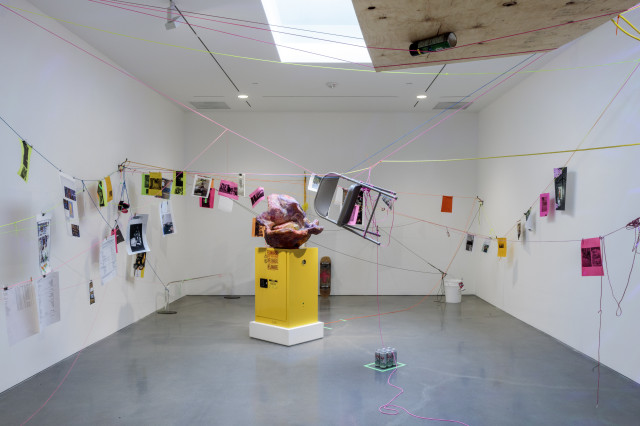
This new installation by Amanda Ross-Ho encompasses architectural elements, large-scale paintings, fabricated objects, textiles, and photographs created specifically for the MOCA Pacific Design Center. AMANDA ROSS-HO: TEENY TINY WOMAN evolves her continued interest in translation, scale, and the authored collapse of authentic gesture and performance. Her work interrogates intimate territories of experience, toggling between the context of production and the context of reception, to create an infinite loop of meaning.
AMANDA ROSS-HO: TEENY TINY WOMAN
![]() 20121007
20121007
Jun 23, 2012-Oct 7, 2012
This new installation by Amanda Ross-Ho encompasses architectural elements, large-scale paintings, fabricated objects, textiles, and photographs created specifically for the MOCA Pacific Design Center. AMANDA ROSS-HO: TEENY TINY WOMAN evolves her continued interest in translation, scale, and the authored collapse of authentic gesture and performance. Her work interrogates intimate territories of experience, toggling between the context of production and the context of reception, to create an infinite loop of meaning. Add to my Calendar
|